Buying Guides
How to Source Wooden Kitchen Utensils from China: An Importer's Guide
Learn how to source wooden kitchen utensils from China: define specifications, evaluate manufacturers, plan OEM/ODM and packaging, and request a quote from Sentai Houseware.
Sourcing wooden kitchen utensils from China requires more than comparing quotations. Importers, wholesalers, and private-label brands should define product specifications, confirm materials and dimensions, verify the manufacturer's production capability, and review compliance documentation before placing an order. Working with a manufacturer that operates its own factory, supports OEM/ODM and private-label production, and can provide relevant documentation helps buyers reduce sourcing risk and plan repeat orders.
Table of Contents
- Define Your Wooden Kitchen Utensil Requirements
- How to Evaluate a Wooden Kitchen Utensil Manufacturer in China
- OEM/ODM, Private Label, and Packaging Requirements
- Quality Control, Compliance, and Order Planning
- Frequently Asked Questions
- Request a Quote from Sentai Houseware
1. Define Your Wooden Kitchen Utensil Requirements
Before contacting a Chinese supplier, importers should prepare a clear product specification. Wooden kitchen utensils vary by wood species, size, shape, finish, and intended use. A clear specification helps manufacturers confirm feasibility, estimate the MOQ, and prepare a relevant quotation.
Start by identifying the products you intend to import.
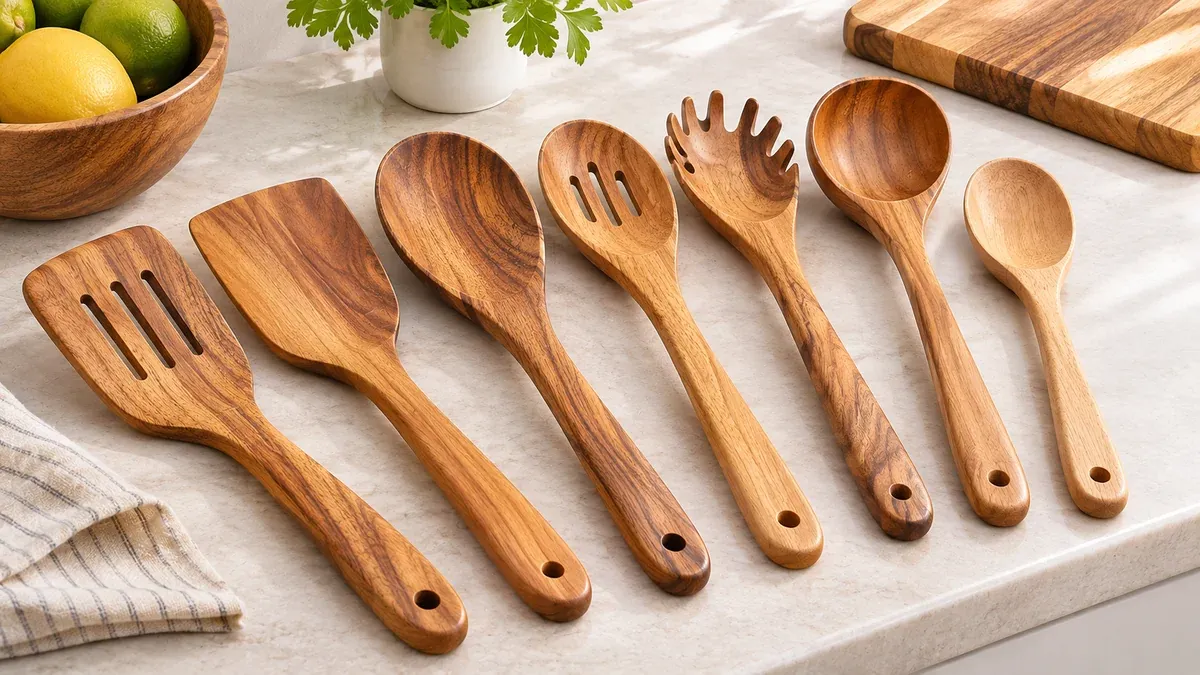
Common wholesale sourcing categories include:
- Wooden spoons: Cooking spoons, serving spoons, and other wooden spoon designs.
- Wooden spatulas: Flat spatulas, cooking turners, and related utensils.
- Wooden utensil sets: Multiple utensils grouped for wholesale distribution or private-label retail.
- Custom wooden kitchen utensils: Products developed according to buyer-provided specifications.
Prepare a product specification sheet
For each requested item, clarify:
- Wood species and material preferences
- Product length, width, thickness, and shape
- Surface finishing and treatment requirements
- Intended food-contact applications
- Logo placement and branding method
- Individual or set packaging requirements
- Target order quantity
- Destination market and applicable requirements
If a design is not finalized, provide reference photographs or technical drawings and identify which features are essential and which can be adapted.
Buyer tip: Ask the manufacturer to confirm material availability, dimensions, and production feasibility before requesting a formal quotation.
2. How to Evaluate a Wooden Kitchen Utensil Manufacturer in China
Choosing a manufacturer involves evaluating production arrangements, communication, documentation, and export coordination. A reliable supplier should be able to explain who manufactures the products, how specifications are confirmed, and what happens if a product does not meet the agreed standard.
Supplier evaluation checklist
Evaluation Area | Questions Importers Should Ask |
|---|---|
Manufacturing | Does the supplier operate its own factory? Where is production located? |
Product capability | Can the manufacturer produce the requested wooden spoons, spatulas, or utensil sets? |
Materials | Can the requested wood species and surface treatment be confirmed? |
OEM/ODM | Can the supplier review custom designs, dimensions, and branding requirements? |
Quality control | How are product specifications and inspection requirements agreed upon? |
Certifications | Which certifications and supporting documents are relevant and available for review? |
MOQ | What is the minimum order quantity for each product or set? |
Lead time | What production schedule can be confirmed for the requested order? |
Packaging | Can the supplier accommodate the required packaging and labeling specifications? |
Export coordination | Which shipping terms and documentation responsibilities can be agreed upon? |
Working with Sentai Houseware
Yiwu Sentai Houseware Co., Ltd. has operated since 2010 and specializes in B2B wooden kitchenware manufacturing. Sentai operates its own factory in Hanjiang, Putian, China. Its product range includes wooden kitchen utensils, wooden bowls and tableware, cutting boards, and selected kitchen storage products. The company supports OEM/ODM manufacturing and private-label cooperation for importers, wholesalers, and private-label brands.
Buyers can review Wooden Spoon and Utensil Set Products and request confirmation of specific product capabilities.
Manufacturing arrangements, customization details, and order requirements should be discussed directly with Sentai before confirming an order.
3. OEM/ODM, Private Label, and Packaging Requirements
OEM and ODM cooperation allows importers to source wooden kitchen utensils according to their market requirements. However, customization should be defined before production rather than treated as a final packaging adjustment.
OEM versus ODM sourcing
OEM (Original Equipment Manufacturing) involves manufacturing products according to buyer-provided designs, specifications, or technical drawings. ODM (Original Design Manufacturing) may involve selecting or adapting existing manufacturer designs according to the agreed project scope. For both arrangements, buyers should confirm which modifications are feasible.
Private-label information to prepare
When requesting a customized product, provide:
- Branding: Logo artwork, preferred placement, and application requirements.
- Product specifications: Drawings, dimensions, materials, and required finishing.
- Packaging: Retail box specifications, labeling, barcode requirements, and any inserts.
- Market information: Destination country and applicable product or labeling requirements.
- Order details: Estimated quantity, product mix, and requested delivery schedule.
For branded wooden utensil sets, confirm whether the MOQ applies to individual utensils or complete sets. Sentai supports OEM/ODM and private-label projects. Specific logo applications, packaging materials, and production requirements should be confirmed for each project. Related sourcing options can be explored through the Wooden Kitchen Utensils Collection.
4. Quality Control, Compliance, and Order Planning
International wooden kitchenware buyers should establish product acceptance criteria before mass production. Important inspection considerations include dimensions, surface smoothness, finishing consistency, visible defects, and packaging accuracy. Testing requirements should reflect the material, intended use, and destination market.
Food-contact and certification documentation
Sentai provides applicable information on FSC certification, amfori BSCI social compliance audits, and relevant FDA and LFGB food-contact requirements. EUDR due diligence support is addressed separately. Buyers should request the relevant documentation for their market and confirm its scope before ordering. FSC documentation, social compliance information, and food-contact documentation address different requirements. For food-contact wooden kitchen utensils, importers should determine which testing and declarations are applicable in their destination market. For EU buyers, Sentai can cooperate with EUDR due diligence support. The applicable documentation and information requirements should be confirmed for the relevant product and order.
MOQ and production lead time
Sentai's MOQ is 500 pcs for single-item products or 500 sets for multi-piece sets, subject to product specifications and customization requirements. Production time is 20–30 days, depending on the confirmed order requirements and production arrangements. Buyers should verify both MOQ and the final manufacturing schedule before ordering.
Recommended purchasing workflow
- Submit product specifications and estimated quantities.
- Request a quotation and confirm customization feasibility.
- Agree on sampling requirements and approval criteria.
- Review relevant compliance and documentation requirements.
- Confirm packaging, production schedule, and quality expectations.
- Approve the final order specifications before production.
Clear written specifications help manufacturers and importers maintain consistent expectations throughout production.
Frequently Asked Questions
1. What is your minimum order quantity?
Sentai's MOQ is 500 pcs for single-item products or 500 sets for multi-piece sets. The exact MOQ depends on the product, specifications, and customization requirements.
2. Can Sentai manufacture private-label wooden kitchen utensils?
Yes. Sentai supports OEM/ODM and private-label cooperation. Buyers can submit drawings, logo artwork, and packaging requirements for review.
3. How long does wooden kitchen utensil production take?
Sentai's production time is 20–30 days. The actual schedule should be confirmed according to the order requirements.
4. What compliance information should importers request?
Buyers should request relevant FSC, BSCI, and food-contact documentation, as applicable. They should confirm the scope and validity of each document for the intended market.
5. What information is needed to request a wholesale quotation?
Provide the product type, dimensions, preferred material, estimated quantity, destination market, branding requirements, and packaging specifications.
Request a Quote from Sentai Houseware
Looking for a wooden kitchen utensils manufacturer in China for your wholesale or private-label business? Yiwu Sentai Houseware Co., Ltd. supports B2B sourcing of wooden spoons, spatulas, utensil sets, and related wooden kitchenware, with OEM/ODM and private-label cooperation. Whether you are sourcing for an established distribution business or developing a private-label product range, Sentai can review your requirements and discuss available manufacturing options.
Send your product requirements and estimated order quantity to begin your sourcing inquiry.